
OTOPLASTICS
High-End Surface Finishing for Additively Manufactured Earmolds
Precision finishing for earmolds
This report highlights the latest advancements in automated surface finishing for earmolds and expands the focus to include the processing of titanium earmolds. Through extensive
testing, OTEC has developed an optimized process that overcomes previous limitations in processing materials like acrylic and silicone while meeting the unique demands of titanium.
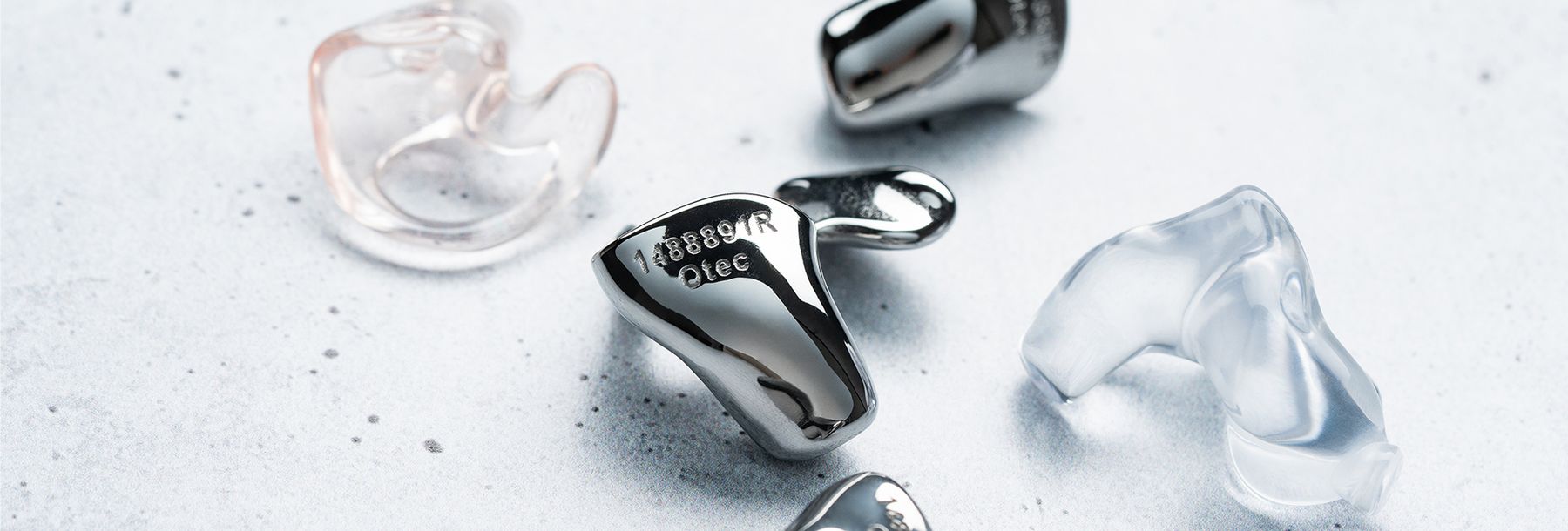
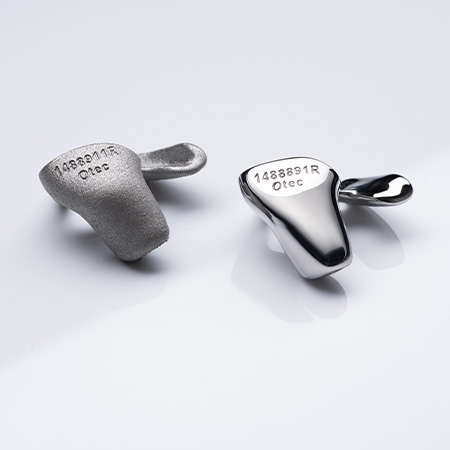
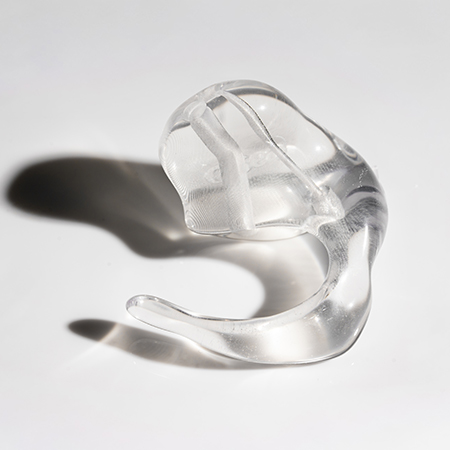
The core result is a significant improvement in surface quality: achieving crystal-clear transparency for plastics and a mirror-like finish for titanium, all without notable loss of form. This breakthrough enables manufacturers to produce more economically while enhancing wearer comfort, aesthetics, and process reliability.
1. INTRODUCTION
1.1 Background and Importance
Hearing impairments significantly impact an individual’s social and psychological well-being. Modern hearing systems are high-performance technologies in miniature form. A critical component of these systems is the custom-made earmold, which ensures a secure fit for the technology and must be nearly invisible and imperceptible to the wearer. Titanium earmolds, in particular, offer a robust and durable alternative, making them ideal for demanding applications.
1.2 Objective
Today, earmolds and titanium earmolds are predominantly manufactured using additive manufacturing (3D printing), resulting in raw parts with inherent surface roughness. The goal of this application optimization was to eliminate this roughness and achieve a high-gloss finish that eliminates the need for manual rework while meeting the highest aesthetic and functional standards.
2. METHODOLOGY AND CHALLENGES
2.1 Challenges in Processing Plastics and Titanium
The processing of materials like acrylic, silicone, and titanium presents distinct yet equally demanding challenges in mass finishing:
Plastics:
- Cloudiness: Surfaces become matte or appear "milky" after processing.
- Loss of Geometry: Aggressive processing can alter the fit of these custom parts.
- Residues: Process media can become lodged in fine channels.
Titanium:
- Mirror Finish Without Form Loss: Titanium requires extremely gentle processing to ensure minimal material removal while preserving intricate geometries
- Process Reliability: Results must be reproducible and stable to ensure consistently high quality.
2.2 Experimental Setup
To address these challenges, the OTEC Finishing Center conducted comprehensive test series, evaluating various process parameters:
- Plastics: Testing innovative combinations of process media, adjusting flow dynamics in CF-Series machines, and optimizing the interaction between abrasive media and workpiece surfaces.
- Titanium: Developing a specialized process media mix that enables minimal material removal while achieving maximum gloss, alongside fine-tuning machine parameters for uniform processing.
The focus was on identifying a process that delivers reproducible, top-tier quality for both milled and printed parts.
3. Results
Arguably the most significant achievement of the new process is its optical quality:
3.1 Exceptional Transparency and Mirror Finish
- Plastics: Achieved brilliance and transparency comparable to or surpassing manual polishing.
- Titanium: Delivered a flawless mirror finish without significant form loss.
3.2 Preservation of Geometry
By fine-tuning machine parameters and using specially tailored media, material removal was controlled to ensure extremely gentle processing. This is essential for achieving a perfect fit in the ear canal.
3.3 Process Stability
The test series demonstrated that the new process is highly stable. Both plastics and titanium achieved homogeneous surface structures free from disruptive deposits or inclusions.
4. ANALYSIS OF BENEFITS
4.1 For Manufacturers (Economic Efficiency)
- Reduction in Manual Labor
The need for manual pre- or post-processing is minimized. - Efficiency
The OTEC CF-Series enables the processing of larger batch sizes in a single operation. - No Mandatory Coating:
Due to the high surface quality, optional coatings are now an aesthetic choice rather than a technical necessity for achieving biocompatibility.
4.2 For End Users (Quality)
- Wearing Comfort
Perfectly smoothed surfaces prevent skin irritation in the sensitive ear area. - Aesthetics
High transparency in plastics and the mirror finish in titanium make the earmold nearly invisible when worn. - Hygiene
Smoother surfaces reduce the accumulation of earwax and bacteria, making cleaning easier.
5. CONCLUSION AND RECOMMENDATION
The new insights from the OTEC Finishing Center have revolutionized the automated processing of earmolds and titanium earmolds. The developed process combines economic efficiency with the highest quality standards.
We recommend that manufacturers of earmolds and titanium earmolds adopt the optimized process parameters of the CF-series to remain competitive and deliver products that delight end users both functionally and aesthetically. The synergy between the machine and the newly defined process media mix guarantees results that truly "stand out" – or, in the best sense, remain invisible.
Press contact

Sven Schmidt
s.schmidt@otec.de
Area Sales Manager
Heinrich-Hertz-Str.24
75334 Straubenhardt
+49 (0) 7082 / 49 11 20
www.otec.de


